

Fluorine Free Battery Electrolytes Market Price Dynamics, Trade Flow and Industry Forecast (2026–2036)
Rising regulatory bans on hazardous fluorinated chemicals and increasing demand for safe, non-toxic energy storage solutions accelerate global market expansion
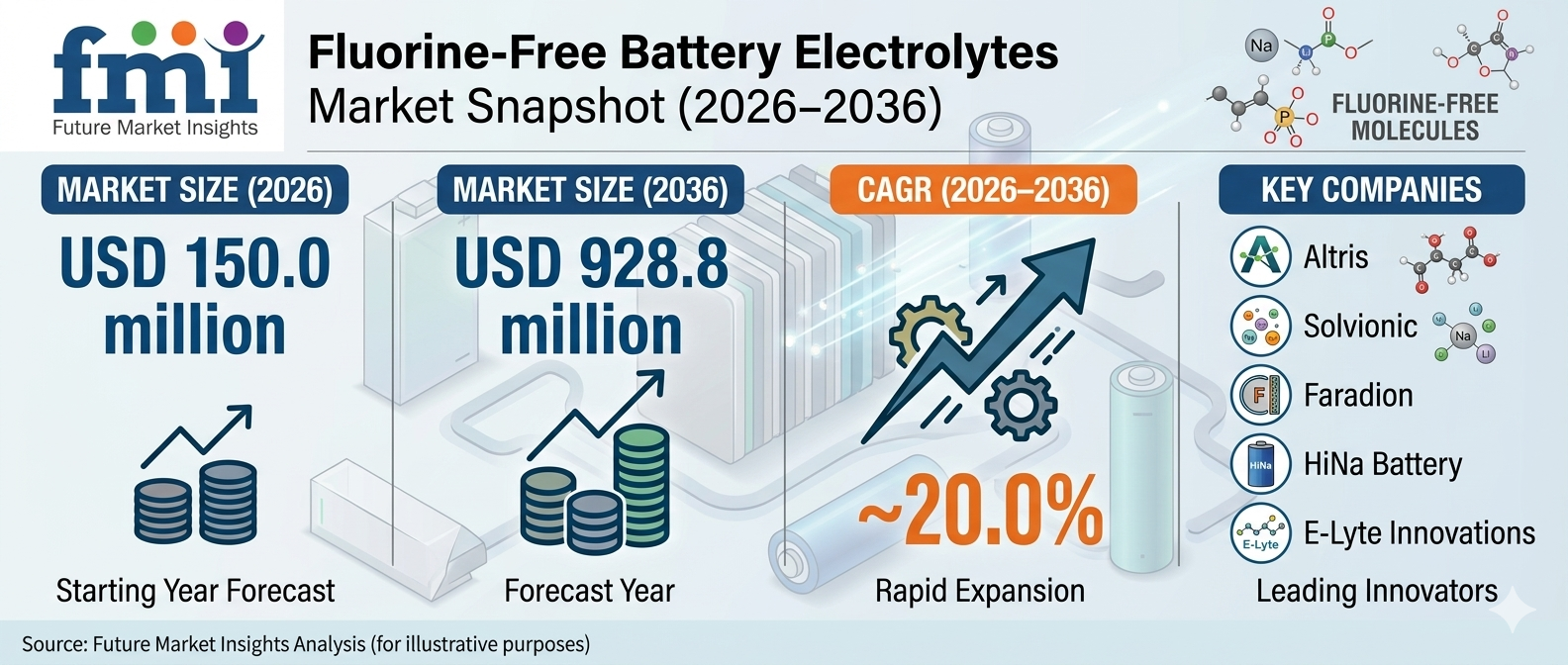
NEWARK, DE, UNITED STATES, March 17, 2026 /EINPresswire.com/ -- The global fluorine-free battery electrolytes market is valued at USD 150.0 million in 2026 and is projected to reach USD 928.8 million by 2036, expanding at a CAGR of 20.0% from 2026 to 2036. Growth is driven by the rapid transition toward non-toxic battery chemistries, increasing deployment of stationary energy storage systems, and tightening environmental regulations banning fluorinated compounds.
As battery technologies evolve to support grid-scale storage and decentralized energy systems, fluorine-free electrolytes are emerging as a critical innovation—transitioning from experimental alternatives into essential components of next-generation battery architectures.
Fluorine-Free Battery Electrolytes Market Snapshot (2026–2036)
• Market size in 2026: USD 150.0 million
• Market size in 2036: USD 928.8 million
• CAGR (2026–2036): ~20.0%
• Leading battery type: Sodium-ion batteries
• Top end-use segment: Energy storage systems
• Dominant electrolyte type: Aqueous solutions
• Fastest-growing country: China
• Key companies: Altris, Solvionic, Faradion, HiNa Battery, E-Lyte Innovations
Market Momentum
The fluorine-free battery electrolytes market begins at USD 150.0 million in 2026, supported by increasing regulatory pressure to eliminate hazardous fluorinated materials. Between 2027 and 2030, commercialization of sodium-ion and aqueous battery systems accelerates adoption, particularly in stationary energy storage applications.
Entering 2032 and beyond, advancements in high-voltage aqueous electrolytes and ionic liquid formulations enable broader deployment across grid-scale installations. By 2036, the market reaches USD 928.8 million, driven by regulatory compliance, safety requirements, and the need for sustainable battery chemistries in urban environments.
Request For Sample Report | Customize Report |purchase Full Report - https://www.futuremarketinsights.com/reports/sample/rep-gb-32257
Why the Market is Growing
The fluorine-free battery electrolytes market is expanding as environmental regulations force the phase-out of polyfluoroalkyl substances and fluorinated salts traditionally used in battery systems. Manufacturers must redesign internal cell chemistry to meet strict safety and sustainability mandates while maintaining electrochemical performance.
Another key growth driver is the increasing deployment of energy storage systems in densely populated areas. Non-flammable, non-toxic aqueous electrolytes allow battery installations without complex fire suppression infrastructure, significantly reducing project costs and regulatory barriers.
Supply chain resilience also plays a crucial role. By eliminating dependence on imported fluorochemicals, countries are investing in localized production of alternative battery materials, strengthening national energy security and reducing exposure to raw material volatility.
Segment Spotlight
1. End Use: Energy Storage Systems Lead Demand
Energy storage systems account for approximately 52% of total demand, driven by utility-scale deployments requiring high safety, low maintenance, and long lifecycle performance. These systems prioritize non-toxic and non-flammable chemistries to mitigate operational risks.
2. Battery Type: Sodium-Ion Batteries Dominate
Sodium-ion batteries hold around 45% share in 2026, supported by their cost advantage, abundant raw materials, and compatibility with fluorine-free electrolyte formulations.
3. Electrolyte Type: Aqueous Solutions Gain Traction
Aqueous electrolytes represent nearly 38% of the market, driven by their inherent non-flammability and suitability for urban and residential energy storage applications.
Drivers, Opportunities, Trends, Challenges
• Drivers:
Regulatory bans on fluorinated chemicals, growth in stationary energy storage, and demand for non-toxic battery materials
• Opportunities:
High-voltage aqueous electrolytes, localized chemical production, and closed-loop battery recycling systems
• Trends:
Shift toward sodium-ion chemistry, development of water-in-salt electrolytes, and OEM-specific electrolyte customization
• Challenges:
Voltage stability limitations, high qualification costs, and scaling production of advanced non-fluorinated materials
Country Growth Outlook (2026–2036)
China leads the market with a projected CAGR of 24.5%, driven by aggressive commercialization of sodium-ion battery technologies and strong government support for alternative energy storage systems. India follows with a 22.0% growth rate, supported by national initiatives to develop localized, fluorine-free battery supply chains.
Germany records a CAGR of 20.5%, reflecting strict environmental regulations and strong industrial adoption of sustainable materials. The United States grows at 19.0%, supported by grid modernization programs and incentives for safe energy storage systems. South Korea and Japan continue steady expansion through advanced material innovation and safety-driven battery development.
Competitive Landscape
The fluorine-free battery electrolytes market is characterized by a growing number of specialized material developers and battery technology firms competing on electrolyte stability, safety performance, and scalability.
Key players such as Altris, Solvionic, Faradion, HiNa Battery, and E-Lyte Innovations are actively investing in advanced electrolyte formulations, including ionic liquids and aqueous systems tailored for sodium-ion and next-generation batteries.
Competition increasingly centers on formulation expertise, compatibility with emerging battery chemistries, and the ability to deliver high-purity, scalable, and environmentally compliant electrolyte solutions. Companies that align closely with battery manufacturers through OEM partnerships are expected to secure long-term supply agreements and gain competitive advantage.
Frequently Asked Questions (FAQ)
What is the global fluorine-free battery electrolytes market size?
The market is valued at USD 150.0 million in 2026 and is projected to reach USD 928.8 million by 2036.
At what rate is the market expected to grow?
The market is forecast to expand at a CAGR of approximately 20.0% from 2026 to 2036.
What are fluorine-free battery electrolytes?
They are non-toxic, halogen-free conductive materials used in rechargeable batteries, designed to replace traditional fluorinated salts while maintaining ion transport and electrochemical stability.
Why are fluorine-free electrolytes gaining importance?
They enable safer, non-flammable battery systems, ensure compliance with environmental regulations, reduce dependency on hazardous chemicals, and support the deployment of energy storage systems in urban environments.
Explore More Related Studies Published by FMI Research:
Biodegradable Polyester-Cellulosi Blend Fiber Market: https://www.futuremarketinsights.com/reports/biodegradable-polyester-cellulosi-blend-fiber-market
Conductive Yarns for E-Textile Sensors Market: https://www.futuremarketinsights.com/reports/conductive-yarns-for-e-textile-sensors-market
Isosorbide-based High-Performance Apparel Fiber Market: https://www.futuremarketinsights.com/reports/isosorbide-based-high-performance-apparel-fiber-market
About Future Market Insights (FMI)
Fture Market Insights, Inc. (FMI) is an ESOMAR-certified, ISO 9001:2015 market research and consulting organization, trusted by Fortune 500 clients and global enterprises. With operations in the U.S., UK, India, and Dubai, FMI provides data-backed insights and strategic intelligence across 30+ industries and 1200 markets worldwide.
Why Choose FMI: https://www.futuremarketinsights.com/why-fmi
Sudip Saha
Future Market Insights Inc.
+1 347-918-3531
rahul.singh@futuremarketinsights.com
Legal Disclaimer:
EIN Presswire provides this news content "as is" without warranty of any kind. We do not accept any responsibility or liability for the accuracy, content, images, videos, licenses, completeness, legality, or reliability of the information contained in this article. If you have any complaints or copyright issues related to this article, kindly contact the author above.
