

Confectionery Ingredients Market to Reach USD 58.9 Billion by 2035 on Clean-Label and Premium Demand
Confectionery Ingredients Market
Confectionery Ingredients Market Gains Momentum as Demand Rises for Traceable, Reduced-Sugar Solutions
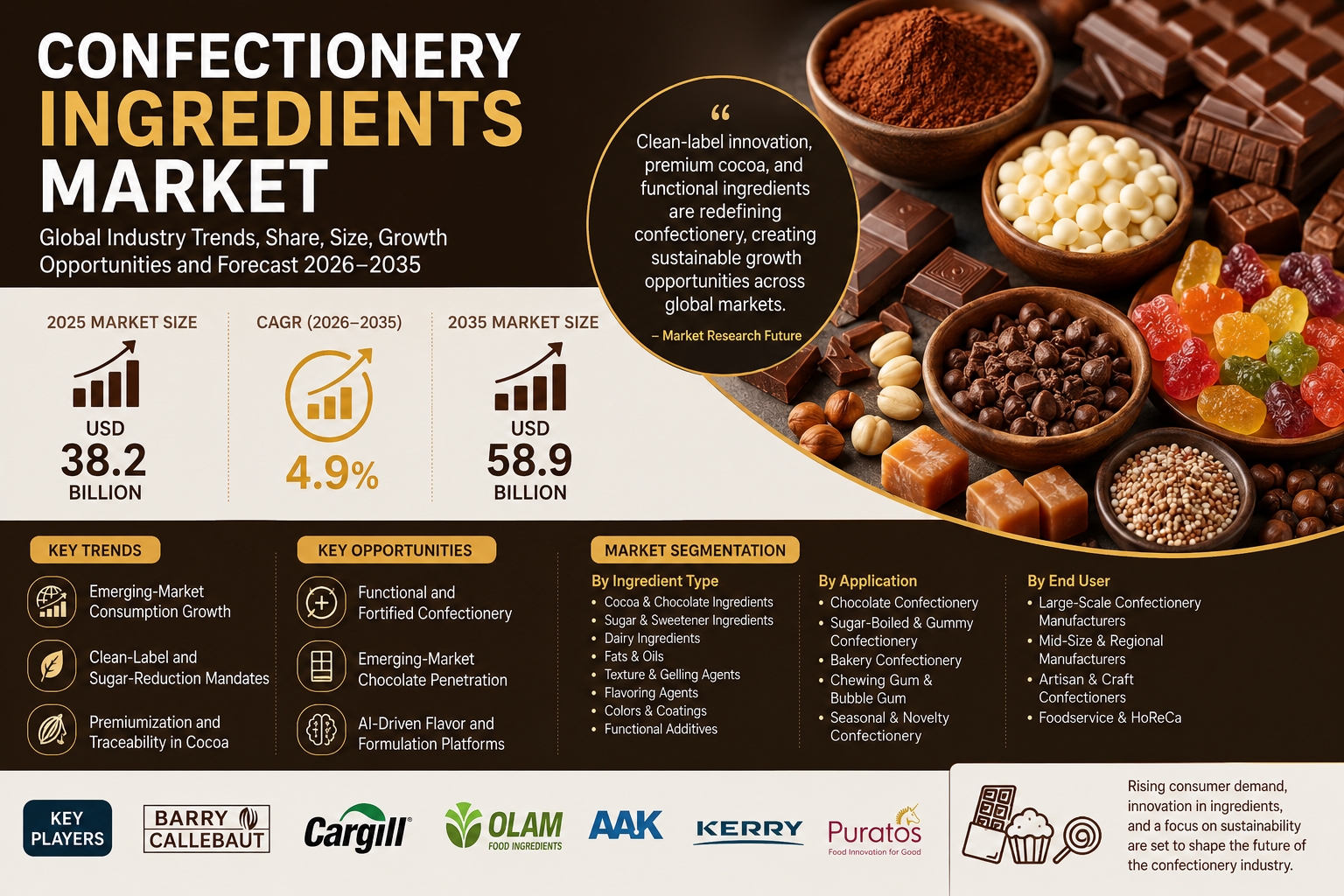
Clean-label innovation, premium cocoa, and functional ingredients are redefining confectionery, creating sustainable growth opportunities across global markets.”
NEW YORK, NY, UNITED STATES, July 8, 2026 /EINPresswire.com/ -- The global Confectionery Ingredients Market is entering a new phase of expansion, supported by shifting consumer preferences, product premiumization, and an accelerating move toward healthier and more transparent formulations. According to the market research future, the market is valued at USD 38.2 billion in 2025 and is projected to rise to USD 58.9 billion by 2035, expanding at a compound annual growth rate (CAGR) of 4.9% during the forecast period 2026 to 2035.— Market Research Future (MRFR)
The market outlook reflects a broader transformation in the confectionery industry, where manufacturers are balancing indulgence with functionality, reformulating for cleaner labels, and investing in traceable supply chains. Demand for confectionery ingredients continues to grow across chocolate confectionery, sugar-boiled and gummy confectionery, bakery confectionery, chewing gum and bubble gum, as well as seasonal and novelty product lines. These segments are increasingly dependent on specialized ingredients that improve taste, texture, shelf life, appearance, and nutritional positioning.
The market’s growth is being supported by a wide range of ingredient categories, including cocoa and chocolate ingredients, sugar and sweetener ingredients, dairy ingredients, fats and oils, texture and gelling agents, flavoring agents, colors and coatings, and functional additives. As confectionery brands compete in a crowded marketplace, ingredient innovation is becoming a central differentiator, enabling companies to create products that are more desirable, more compliant with health-focused expectations, and better aligned with regional consumer preferences.
Industry Shift Toward Clean Label and Sugar Reduction
One of the most important trends shaping the confectionery ingredients market is the rapid shift toward clean-label formulations. Consumers are increasingly paying attention to ingredient lists, sourcing claims, and the overall transparency of packaged food. In response, manufacturers are reformulating products to reduce artificial additives and simplify ingredient declarations without sacrificing taste or texture.
At the same time, sugar-reduction mandates and consumer health awareness are encouraging the use of alternative sweeteners, functional additives, and texture-enhancing solutions that preserve sensory appeal. This trend is especially significant for chocolate confectionery and sugar-based confectionery products, where taste and mouthfeel are critical to consumer satisfaction. Ingredient suppliers that can deliver sweetness, stability, and indulgence in reduced-sugar formats are expected to benefit from strong demand over the coming decade.
The market is also seeing increased use of dairy ingredients, fats and oils, and functional additives in support of better product structure, improved shelf stability, and enhanced nutritional positioning. These ingredients play a key role in meeting consumer expectations for premium quality while allowing manufacturers to adapt recipes for modern dietary and labeling requirements.
Get Full PDF Sample Copy of Report: (Including Full TOC, List of Tables & Figures, Chart) @ https://www.marketresearchfuture.com/sample_request/4564
Premiumization and Traceability Continue to Reshape Cocoa Demand
Another defining trend in the market is the growing emphasis on premiumization, particularly in cocoa and chocolate-based products. Consumers are increasingly drawn to confectionery items that offer richer flavor profiles, superior textures, and a more artisanal or indulgent experience. This is helping to fuel demand for high-quality cocoa and chocolate ingredients, especially in premium chocolate bars, filled chocolates, seasonal gift products, and specialty bakery confectionery.
Alongside premiumization, the industry is placing greater importance on traceability in cocoa sourcing. Brands and manufacturers are under rising pressure to demonstrate responsible procurement practices, ethical sourcing, and supply chain visibility. This has elevated the strategic value of suppliers that can provide traceable cocoa ingredients and support sustainability commitments. For multinational confectionery producers and regional brands alike, traceability is no longer a secondary consideration; it is becoming a core factor in purchasing decisions and brand reputation.
Emerging-Market Consumption Growth Offers Significant Opportunity
The confectionery ingredients market is also being supported by consumption growth in emerging markets, where rising disposable incomes, urbanization, and changing lifestyles are increasing demand for packaged snacks and sweet treats. In many developing economies, confectionery products are becoming more accessible through modern retail channels, e-commerce, and expanded foodservice distribution.
This demand growth is particularly relevant for chocolate confectionery, gummies, and novelty products, which often serve as entry points for consumer spending in the category. As more consumers in emerging markets purchase branded confectionery products, ingredient suppliers are finding new opportunities to support local manufacturing, adapt formulations to regional preferences, and supply cost-effective yet differentiated ingredient solutions.
The expanding middle class in these regions is also contributing to the rise of premium and aspirational confectionery consumption. This creates a dual-market opportunity: mass-market products require efficient, scalable ingredients, while premium products demand higher-end cocoa, flavor systems, coatings, and specialty texture solutions.
Functional and Fortified Confectionery Create a New Growth Path
The market outlook is further strengthened by the rise of functional and fortified confectionery. Today’s confectionery consumers are not only looking for flavor and indulgence but also for products that align with wellness goals, energy support, or enhanced nutritional value. This has encouraged manufacturers to experiment with ingredients that can support added functionality, including protein-enriched formulations, reduced-sugar systems, fiber-enriched products, and ingredients that improve digestive or lifestyle positioning.
Functional confectionery is opening new possibilities across chocolate, gummies, bakery confections, and even chewing gum. As consumers become more open to products that blend enjoyment with perceived benefits, ingredient innovation will remain essential. Suppliers that can offer stable, compatible, and high-performing ingredients for fortified applications are likely to see stronger demand, especially from manufacturers targeting health-conscious adults and premium snack segments.
AI-Driven Flavor and Formulation Platforms Accelerate Innovation
Technology is also becoming a major force in the confectionery ingredients market. AI-driven flavor and formulation platforms are helping manufacturers and ingredient suppliers accelerate product development, optimize recipes, and predict consumer preferences more effectively. These tools can reduce time-to-market, improve consistency, and support iterative innovation across product categories.
For confectionery producers, this is particularly valuable because the category is highly sensitive to taste, texture, melting behavior, and appearance. Even small formulation changes can significantly affect consumer acceptance. AI-powered development platforms allow companies to test ingredient combinations more efficiently, identify cost-performance tradeoffs, and tailor products for specific regions or consumer groups.
As digital capabilities become more integrated into product development pipelines, confectionery ingredient suppliers may gain a stronger competitive edge by pairing technical expertise with data-led formulation support. This combination is especially useful for customers seeking reduced-sugar, clean-label, and premium-format innovations.
Segment Outlook by Ingredient Type
The market is diverse, with each ingredient category contributing to the performance and differentiation of finished confectionery products.
Cocoa and chocolate ingredients remain a core growth driver, supported by premium chocolate demand and the broad popularity of cocoa-based products across global markets. Rising interest in dark chocolate, filled chocolates, compound coatings, and indulgent seasonal products is sustaining demand for high-quality cocoa liquor, cocoa butter, cocoa powder, and chocolate blends. At the same time, manufacturers are paying closer attention to sustainability, traceability, and ethical sourcing, which is increasing the importance of certified and responsibly sourced cocoa ingredients.
Sugar and sweetener ingredients are evolving in response to health and regulatory pressures, with reformulation trends creating demand for alternatives that preserve sweetness and texture. Producers are increasingly using high-intensity sweeteners, polyols, natural sweeteners, and blended systems to reduce sugar content while maintaining taste, bulk, and mouthfeel. This shift is especially important in sugar-free and reduced-sugar confectionery, where balancing flavor, stability, and consumer acceptance remains a major technical challenge.
Dairy ingredients continue to be important in creamy fillings, chocolates, and bakery confections, supporting richness and mouthfeel. Milk powders, whey derivatives, butterfat, and cream-based ingredients help improve flavor depth, smoothness, and overall sensory appeal, particularly in premium and indulgent products. Demand is also being supported by the growing popularity of milk chocolate, caramel-filled products, and bakery items that rely on dairy for softness and a more luxurious eating experience.
Fats and oils play a central role in product structure, gloss, snap, melt properties, and shelf life. These ingredients are essential for controlling crystallization, improving texture, and ensuring consistent performance during manufacturing and storage. In chocolate and compound coatings, fats and oils influence melting behavior and mouthfeel, while in gummies and bakery confections they help maintain stability and product quality across different climates and distribution channels.
Texture and gelling agents are vital in gummies, jellies, and similar products, where chewiness and consistency are key. Ingredients such as gelatin, pectin, starches, and plant-based alternatives are widely used to create the desired bite, elasticity, and set characteristics. As consumer demand grows for vegan and plant-based confectionery, manufacturers are increasingly exploring alternative gelling systems that can deliver comparable texture without animal-derived inputs.
Flavoring agents help manufacturers differentiate products and localize taste profiles for different markets. From fruit, mint, caramel, and vanilla to more adventurous and seasonal flavor combinations, these ingredients are central to product innovation and consumer appeal. Flavor systems are also being used to mask off-notes in reduced-sugar or fortified formulations, making them especially valuable in health-oriented confectionery development.
Colors and coatings are used to enhance visual appeal and seasonal product design. Bright, stable, and appealing color systems help confectionery products stand out on shelves and support themed launches, festive assortments, and novelty items. Coatings also contribute to shine, protection, and product identity, making them important for both aesthetic value and functional performance in chocolate, gummies, and decorative bakery applications.
Functional additives are gaining attention as brands seek improved shelf stability, nutritional enhancement, and formulation flexibility. These ingredients can support emulsification, preservation, moisture control, fortification, and texture optimization, helping manufacturers adapt to changing consumer expectations and production requirements. As the market moves toward cleaner labels and more health-conscious offerings, functional additives are becoming increasingly important in enabling innovation without compromising product quality.
Together, these ingredient classes form the backbone of confectionery innovation and industrial production worldwide.
Application Demand Remains Broad-Based
Across applications, chocolate confectionery remains one of the most influential segments, thanks to its scale, premiumization potential, and global consumer appeal. Sugar-boiled and gummy confectionery continue to grow strongly due to their convenience, flavor variety, and popularity among younger consumers. Bakery confectionery also represents a substantial opportunity, especially where ingredient solutions are needed to enhance taste, appearance, and shelf stability.
Meanwhile, chewing gum and bubble gum rely on specialized ingredient functionality to achieve the right chew, flavor release, and product durability. Seasonal and novelty confectionery remains a valuable segment for innovation, gifting, and limited-edition product launches, all of which depend on visually appealing colors, coatings, and flavor systems.
Competitive Landscape and Key Players
The market features a competitive set of leading ingredient suppliers and food companies, including Barry Callebaut, Cargill, Olam Food Ingredients, AAK, Kerry Group, and Puratos. These companies are well positioned to benefit from ongoing demand for quality ingredients, formulation support, and global supply capabilities.
Competition is expected to intensify as customers seek suppliers that can offer not only standard ingredients but also sustainable sourcing, customized development, and responsive technical service. The ability to support both large-scale industrial manufacturing and artisan or craft confectioners will be increasingly valuable, particularly as the market diversifies across channels and consumer occasions.
End-User Dynamics Reflect a Diverse Buyer Base
Demand for confectionery ingredients comes from a wide variety of end users. Large-scale confectionery manufacturers continue to account for significant volumes due to their global production footprint and broad product portfolios. Mid-size and regional manufacturers are an important growth segment, especially in emerging markets where localized taste preferences and market agility matter greatly.
At the same time, artisan and craft confectioners are contributing to demand for premium and specialty ingredients that support differentiation, authenticity, and small-batch quality. Foodservice and HoReCa operators also contribute to ingredient demand through desserts, baked sweets, and other confectionery-inspired menu items. This diverse buyer landscape helps support steady market resilience across economic cycles.
Regional Opportunity and Future Outlook
Regionally, the market is expected to benefit from both mature confectionery consumption centers and high-growth emerging economies. Mature markets are likely to emphasize premiumization, sugar reduction, ethical sourcing, and functional innovation, while emerging regions may prioritize affordability, availability, and flavor variety. This dual dynamic creates space for ingredient suppliers that can serve multiple market needs simultaneously.
Looking ahead to 2035, the confectionery ingredients market is expected to be shaped by a combination of consumer health trends, product indulgence, sourcing transparency, and digital innovation. Suppliers that invest in sustainable cocoa sourcing, formulation science, alternative sweetening systems, and AI-enabled product development will be best positioned to capture new opportunities.
With the market forecast to increase from USD 38.2 billion in 2025 to USD 58.9 billion by 2035, the next decade is likely to bring steady expansion and meaningful transformation across the confectionery value chain. As manufacturers continue to balance taste, health, premiumization, and efficiency, ingredients will remain at the center of category growth.
Discover Related Research Reports By Market Research Future:
Dairy Protein Ingredients Market
https://www.marketresearchfuture.com/reports/dairy-protein-ingredients-market-27123
Energy Ingredients Market
https://www.marketresearchfuture.com/reports/energy-ingredients-market-27239
Protein Ingredients Market
https://www.marketresearchfuture.com/reports/protein-ingredients-market-1244
Sagar Kadam
Market Research Future
+1 628-258-0071
email us here
Legal Disclaimer:
EIN Presswire provides this news content "as is" without warranty of any kind. We do not accept any responsibility or liability for the accuracy, content, images, videos, licenses, completeness, legality, or reliability of the information contained in this article. If you have any complaints or copyright issues related to this article, kindly contact the author above.
